
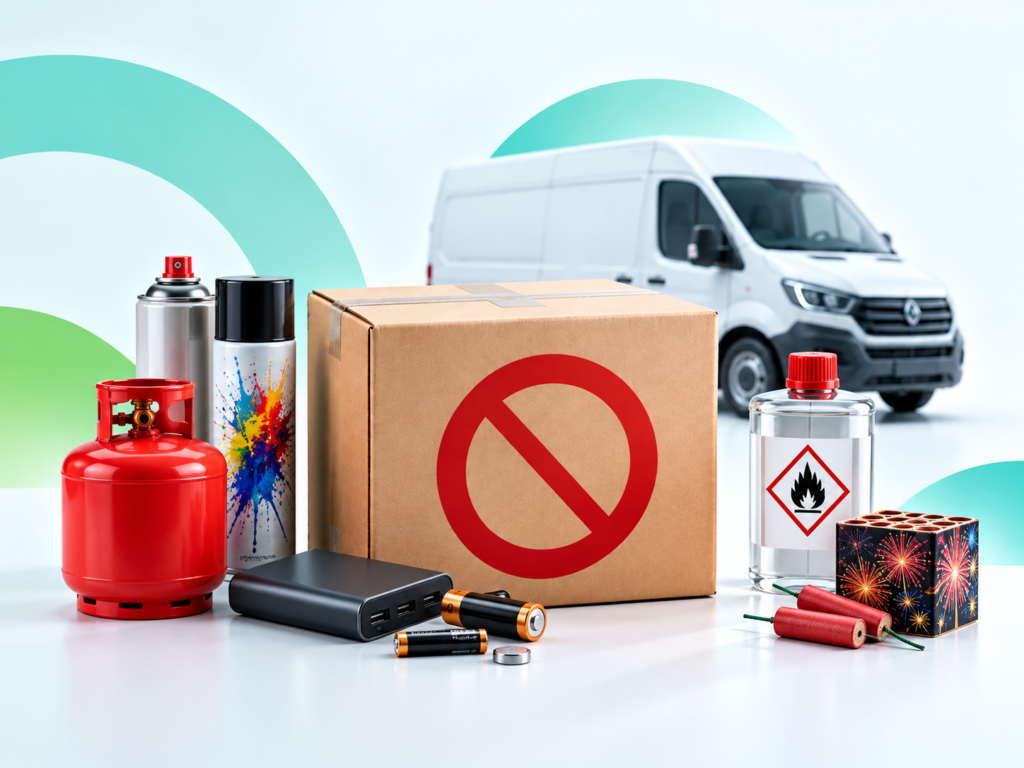
You can’t send anything illegal by courier in the UK, and most carriers refuse or restrict dangerous goods: things that can burn, explode, leak or give off gas, such as spray paint, lighter fuel, loose lithium batteries and gas canisters. A second, larger group is allowed only with conditions, like a cap on how many bottles of perfume go in one parcel, and a third is simply too big, heavy or awkward for a parcel network even though nothing about it is dangerous.
Which group your item falls into depends on what it is and on the kind of service you book. A postal or parcel network has to plan for every box sharing a sorting belt, a lorry and sometimes an aircraft with thousands of others, so its rules are strict and very specific. A van booked for your goods alone is a different situation, though the law still applies to it. This guide goes through the items that catch people out, with the actual limits that apply at the time of writing.
What can’t you send by courier in the UK?
It helps to sort items into three groups before you look anything up.
Prohibited by law. Controlled drugs, counterfeit money, banned weapons and indecent material. No courier will carry these, and no amount of packaging changes that.
Prohibited or restricted for safety. These are dangerous goods: flammable liquids, compressed gas, corrosives, explosives (including fireworks and party poppers), and some batteries. A parcel network will usually refuse the worst of them outright and accept smaller, everyday versions under tight conditions.
Not suited to the service. A 2.4 metre worktop, a car bumper or a 60 kg engine block is perfectly legal. It just won’t fit the conveyors, cages and weight limits a parcel network is built around, so it needs a vehicle rather than a label.
Every carrier publishes its own list, and they differ in the detail. The most complete public one is the Post Office’s list of prohibited and restricted items, which covers Royal Mail and Parcelforce Worldwide. Most of the figures below come from it. If you are booking with someone else, check their list too, because a network that takes one item might refuse another.
Items no courier can legally carry
This part is short, because it is not a matter of carrier policy. Illegal drugs, counterfeit notes or stamps, and weapons that are banned in the UK (flick knives, stun guns, CS gas and pepper spray among them) can’t be sent by anyone. A courier who knowingly carried them would be committing an offence as well.
Some things sit just outside that line and cause confusion. A sporting shotgun or rifle is legal to own with the right certificate, and Royal Mail does accept some sporting guns under strict conditions, but Parcelforce takes only low-powered air weapons, and many couriers refuse firearms of any kind. If you need to move one, speak to the carrier before you book, not at the door.
Dangerous goods: the everyday surprises
The items that trip people up are rarely exotic. They are things from the bathroom cabinet, the garage shelf and the kitchen drawer, which happen to be classed as dangerous in transport because they are flammable or under pressure.
Here is how the Post Office treats some of the common ones for UK parcels, at the time of writing.
| Item | UK post at the time of writing | The catch |
|---|---|---|
| Deodorant, hairspray, shaving foam | Allowed with restrictions | 500 ml per can, no more than two cans per parcel, sent from a Post Office counter |
| Spray paint, air freshener, oven cleaner | Not allowed | Aerosols that aren’t toiletries or medicines are refused completely |
| Perfume and aftershave | Allowed with restrictions | 150 ml per bottle, no more than four per parcel, in original retail packaging |
| Nail varnish | Allowed with restrictions | 30 ml per bottle, no more than four per parcel |
| Nail varnish remover, solvent paint, lighter fluid | Not allowed | Flammable liquids are prohibited |
| Spirits between 24% and 70% ABV | Allowed with restrictions | 1 litre per bottle, two bottles per parcel; anything over 70% is refused |
| Gas canisters, SodaStream cylinders, fire extinguishers | Not allowed | Compressed gas is prohibited, including empty cylinders |
| Matches and used lighters | Not allowed | New, empty lighters in retail packaging are accepted |
A few on that list surprise almost everyone. Life jackets are refused because many contain a gas cartridge. Christmas crackers are fine in their retail box, but the snaps sold on their own are classed as explosives. Weedkiller and fly spray are out, and so is anything containing peroxide, which takes in a good number of hair dyes.
The limits per parcel matter more than they look. Say a salon is sending a new branch 12 bottles of nail varnish and six cans of hairspray by post. At four bottles and two cans per parcel, that is at least three parcels, each handed over at a counter with the right label. A business sending stock in any quantity soon finds the postal route slow and fiddly, even when every individual item is allowed.
Lithium batteries, phones and laptops
Lithium batteries are where most senders come unstuck, because nearly every gadget has one and the rules turn on how the battery is packed.
Installed in the device
A phone, tablet or laptop with its battery fitted can go in the UK post. The Post Office limits are no more than four cells or two batteries installed in devices per parcel, and no more than 100 Wh per lithium-ion battery. Most laptop batteries sit comfortably under that; the rating is printed on the battery or its label. Damaged or swollen batteries can’t be sent at all.
Loose batteries and power banks
Loose batteries are the part people miss. New or used lithium batteries sent on their own, without the device they power, are not accepted in the post. That includes power banks. A spare battery packed in the same box as its device is allowed, but only the number needed to run it plus two spares.
E-bikes and e-scooters are their own problem. Their batteries are usually rated well above 100 Wh, so the parcel networks won’t take them as a normal parcel. If you are moving one, the battery is the first thing to ask the courier about.
If what you actually need is a few laptops moved between offices on the same day, our laptop courier service handles exactly that, with the devices travelling in one vehicle rather than through a sorting network.
Knives and other bladed items
Knives have their own rules, and they fall on the seller rather than the courier.
Under section 38 of the Offensive Weapons Act 2019, a business that sells a bladed product without meeting the buyer commits an offence if it delivers it, or arranges delivery, to a residential address. The section has applied in England and Wales since April 2022 and in Scotland since June 2022. In practice, many online knife sellers deliver to a business address or a collection point instead.
The carriers add their own layer. The Post Office doesn’t accept bladed items across the counter at all, and Parcelforce Worldwide prohibits them on every service. Kitchen utensils and garden tools with sharp edges are a separate category and can usually be sent, as long as the edges and points are wrapped in heavy card so they can’t cut through the box.
If you are a business sending tools or catering knives to another business address, the residential rule doesn’t bite, but the courier still needs to know what is in the box.
Allowed, but not by every service
Plenty of things are legal and harmless, yet still refused by one service and welcomed by another.
Big, heavy and awkward items. Parcelforce Worldwide refuses car panels, doors, bumpers and bonnets, purely because of their size and shape. Most parcel networks stop at around 30 kg per item, and many add surcharges well before that for long or oddly shaped boxes. A van has none of those limits; the question becomes which van fits the load.
Liquids. Liquids that aren’t dangerous goods can go in the UK post, sealed in a leak-proof liner, but Parcelforce caps them at 5 litres per container. A 20 litre drum of non-hazardous floor cleaner is easier to move in a vehicle.
Food and other perishables. Royal Mail accepts perishables in the UK only if they can survive a journey of up to 48 hours, and it refuses ice packs made of frozen water and dry ice. That rules out a lot of fresh food, and sending meat or dairy from Great Britain to Northern Ireland has extra restrictions on top.
Live animals. Pets, reptiles and other live animals are refused by the postal networks. Some insects and worms are allowed, which is mainly of interest to anglers and reptile keepers.
Cash, jewellery and other valuables
These are usually allowed but not covered. Many services exclude cash, jewellery and precious metals from compensation entirely, and the Post Office points out that only one of its services covers them. The same pattern shows up in courier insurance, where cash and jewellery are common exclusions. Our guide to goods in transit insurance explains what is normally left out, and our advice on sending fragile and high-value goods covers packing and declaring value.
Does a dedicated van change the rules?
Partly. A van booked for one customer doesn’t go through a sorting hub, never goes on a plane, and isn’t loaded alongside thousands of strangers’ parcels. That is why it can take things a parcel network can’t: the bumper, the 20 litre drum of floor cleaner, a 3 metre length of pipe, or forty boxes that have to arrive together. Our van courier service sizes the vehicle to the load, and a same-day courier drives it straight from collection to delivery.
What a van doesn’t do is take you outside the law. Carrying dangerous goods by road in Great Britain is governed by the Carriage of Dangerous Goods and Use of Transportable Pressure Equipment Regulations 2009, which apply the European agreement known as ADR. The HSE’s guide to ADR carriage sets out who the rules apply to, and it makes clear that delivery firms can’t rely on the exemption meant for businesses that only carry dangerous goods now and then. Small retail quantities, such as a few boxed cans of deodorant, are handled very differently from a 200 litre drum of solvent, but both have to be declared.
So the honest answer is that a van widens what is practical, and the rules on dangerous goods still apply in full. Our terms ask customers to declare any hazardous, restricted or prohibited goods before collection, and we can decline a booking we aren’t able to carry safely.
What happens if you don’t declare it
The best case is that the driver spots it at collection and the job doesn’t go ahead, which costs you the slot. Worse cases follow if it travels undeclared. A leaking can of solvent can ruin everything else in the vehicle, and an insurer can refuse a claim for goods that were misdescribed. Carriers’ terms generally let them dispose of unsafe items and pass the cost back to the sender.
Telling the courier what is in the box takes thirty seconds when you book. If something is borderline, that is the moment to ask.
Questions about prohibited items
Can I send perfume by courier in the UK?
Yes, with limits. At the time of writing, the Post Office accepts perfume and aftershave for UK addresses at up to 150 ml per bottle and four bottles per parcel, in the original retail packaging and handed over at a counter. It is refused for international post. Other networks set their own limits, so check before you pack a full gift set.
Can I send a power bank or a spare laptop battery?
Not on its own by post. Royal Mail and Parcelforce refuse loose lithium batteries, new or used, and that includes power banks. A spare packed with the device it powers is allowed, up to two spares. For a dedicated vehicle, tell the courier what the battery is and its watt-hour rating when you book.
Can a courier deliver a knife to a home address?
A business that sells a knife online commits an offence if it delivers it, or arranges delivery, to a residential address, under section 38 of the Offensive Weapons Act 2019. Most sellers ship to business premises or a collection point instead. The Act’s definition is aimed at blades capable of causing a serious injury, but carriers often apply wider rules of their own.
Are the rules different for sending abroad?
Yes, and usually stricter. Many items that the Post Office accepts within the UK, including perfume, aerosols, nail varnish and spirits, are refused for international post. Each destination country has its own import restrictions on top. Our guide to shipping goods internationally from the UK covers the paperwork side.
Who is responsible if a prohibited item is sent?
The sender, before anyone else. Carriers’ terms put the duty on the person booking to describe the goods accurately and declare anything hazardous or restricted. If you don’t, the carrier can refuse or dispose of the item, recover its costs, and decline any claim. For dangerous goods sent by road, the regulations also place legal duties on the consignor.
In short
Anything illegal is out everywhere. Dangerous goods, which take in everyday things like spray paint, solvent, gas cylinders and loose lithium batteries, are refused by the postal networks or accepted only in small quantities with set packing rules. A long list of harmless items is legal but simply wrong for a parcel network because of its size, weight or shape. A dedicated van removes the size problem and the per-parcel limits, but not the law on dangerous goods.
If you are not sure whether something can travel, request a quote and describe the item, its size and weight, and anything about it that might count as hazardous. We will tell you before collection whether we can carry it and what vehicle it needs.

Written by
Fabian Oliver — Content Writer, Flextro
Fabian is a content writer at Flextro, a UK-based dedicated courier and same-day delivery company. He writes clear, practical guidance on courier services, logistics, and delivery for UK businesses — from same-day and emergency deliveries to pallet freight, eCommerce fulfilment, and contract runs. Drawing on the expertise of the wider Flextro team, Fabian helps business owners make smarter, safer decisions about moving their goods, without the jargon.