
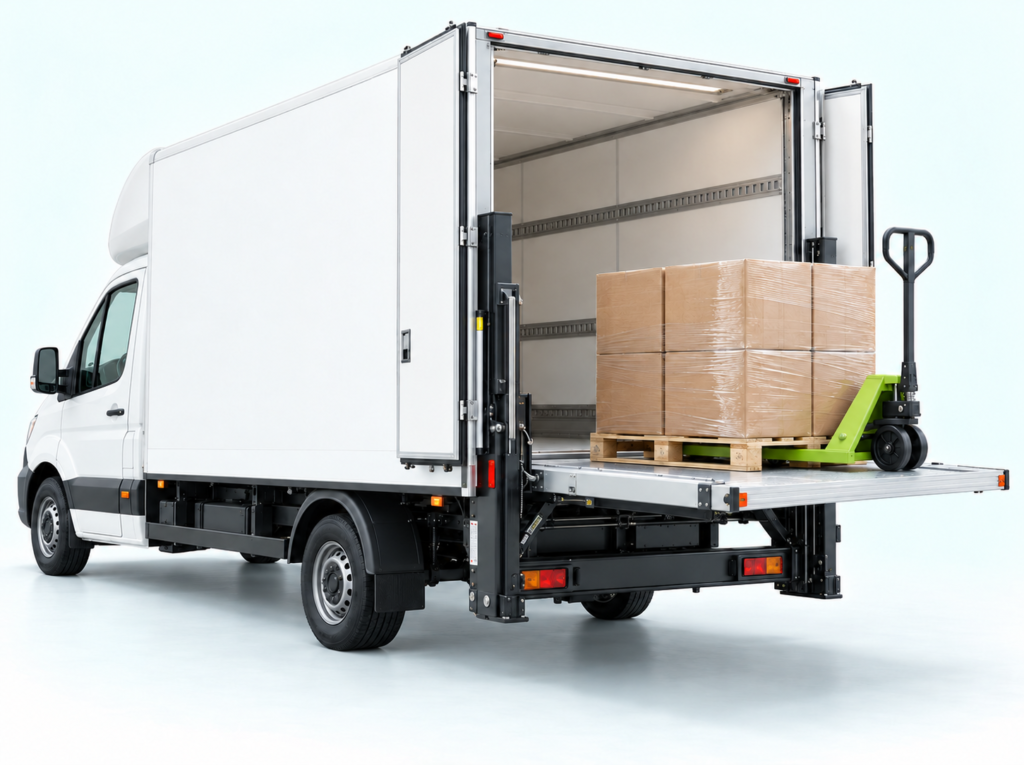
A tail lift is a powered platform fixed to the back of a van or lorry that raises goods from the ground up to the load floor, and lowers them back down at the other end. You need one when something is too heavy or awkward to lift into the vehicle by hand and there is no loading bay or forklift waiting at both ends.
So what is a tail lift used for in practice? Most pallets going to shops, workshops and homes, and plenty of single heavy items: a safe, a generator, a stone garden ornament. A tail lift solves the vertical problem, getting the load up to floor height and down again. It does nothing about steps, gravel, a sloping drive or a narrow side passage, and those are what usually decide whether a delivery goes smoothly.
What is a tail lift, and how does it work?
On a typical van or lorry the load floor sits somewhere around knee to waist height. A tail lift bridges that gap. The platform folds up against the back doors (or tucks underneath the body) while the vehicle is moving. At the drop, the driver lowers it, wheels or carries the goods on, and uses a hand control to raise or lower the platform hydraulically.
The platform is usually a flat steel or aluminium plate with a small lip at the outer edge to stop a pallet truck rolling off. Most have a control box on the side of the body, and many also have a foot or hand control on the platform itself so the operator can ride it with the load.
In the courier world, you’ll mostly meet tail lifts on Luton vans, the box-bodied vans with the cab that sticks up over the front. Our van courier service runs vans from a small van up to a Luton with a tail lift, and the Luton is the one we send when the freight can’t be lifted in by hand. Panel vans such as a long-wheelbase Transit don’t normally have one, because the body isn’t built to take the weight of the lift mechanism.
Lorries on pallet network rounds carry them too. Same principle, bigger platform.
The main types of tail lift
There are three common designs. You don’t need to know which one is coming, but it explains why a driver asks about the space behind the vehicle.
| Type | Where it sits when stowed | Usually found on | What it means for you |
|---|---|---|---|
| Column | Folded up behind the rear doors, running on two upright columns | Luton vans and smaller box bodies | Light and quick to use. Needs clear space directly behind the vehicle. |
| Cantilever | Folded up as the rear door, on arms under the body | Larger box lorries | Can tilt to meet a sloping road. Swings out further, so needs more room. |
| Tuck-under (slider) | Folded and slid away under the body | Lorries that also use loading bays | Leaves the doors free for a bay. Takes a little longer to deploy. |
The type matters less than the rating, which is marked on the lift itself. Every tail lift has a rated load, and every load that goes on it, plus anything else on the platform at the same time, has to stay inside it.
Do you need a tail lift?
Ask one question about each item: can two people lift this into the back of a van safely, without strain, and without dropping it? If the answer is no, you need a tail lift or a site with handling equipment.
There’s no legal weight limit that settles it. The Health and Safety Executive’s guidance on manual handling is clear that the law does not set a maximum weight for lifting; it asks employers to assess the load, the task and the people doing it, and to avoid hazardous lifting where they reasonably can. A 40 kg box with good handholds is a different job from a 40 kg sheet of glass.
In practice, these are the loads where a tail lift is normally the right call:
- Any pallet, unless both ends have a forklift or a loading bay at the right height.
- Single items over about 50 kg that can’t be split down: safes, engines, small machine tools, cast iron radiators, a full drum of oil.
- Tall or unstable items on wheels, like a commercial fridge or a racking frame, which are safer rolled on at ground level than tipped up a ramp.
- A lot of heavy boxes at once. Twenty 25 kg bags of adhesive aren’t impossible by hand, but stacking them on a pallet and lifting the lot is quicker and kinder to the driver’s back.
And these are the cases where you probably don’t:
- Both addresses have a loading bay, or a forklift that can unload from the side or rear of the vehicle.
- The goods are boxed and each box is a comfortable one-person lift.
- The item is heavy but needs carrying up stairs or through a house anyway. A tail lift only gets it to the pavement; after that it needs people.
That last point catches people out. If a 90 kg range cooker is going into a first-floor flat, the lift deals with the first metre and the stairs deal with the rest. For that kind of job our two-man delivery service is usually the better fit, because the problem is the carrying, not the height of the van floor.
If you’re not sure which vehicle the load needs in the first place, our guide on what size courier van you need covers payloads and load space for each van size.
What the delivery site needs
This is where most failed tail-lift deliveries go wrong. The lift will happily lower a pallet to the ground. Whether it can go anywhere after that depends on the ground.
Level, hard standing behind the vehicle. The platform needs to sit flat on a firm surface. Tarmac, concrete and block paving are fine. Gravel, grass and soft ground are not, because a loaded pallet truck sinks and won’t roll.
Room to open the lift. A column lift needs the platform’s depth plus space to work behind it, so allow at least a couple of metres clear behind the van. A cantilever lift on a bigger vehicle needs more. Parked cars, bollards and a narrow lane can all stop the lift going down.
A route from the kerb to the door. A pallet truck needs a smooth, flat path. It can’t climb a step, cross a door threshold of more than a couple of centimetres, or be held back safely on a slope. A loaded pallet on a downhill drive is how people get hurt.
Somewhere to put it. Many tail-lift deliveries are kerbside: the goods come off the platform and are left at the nearest suitable point. If you need it moved into a garage or warehouse, say so, and check the route is clear.
Here’s an example. A customer orders a pallet of porcelain tiles, about 700 kg, to a house with a block-paved drive that rises gently from the road. The van can lower the pallet onto the pavement. Pushing 700 kg uphill on a hand pallet truck is not something a driver should attempt, so the realistic answer is to break the pallet down at the kerb and carry the boxes up, or to ask the supplier to split it into two lighter pallets before it ships. Knowing that before the booking saves a wasted trip.
The same thinking applies at collection. Our guide to preparing a pallet for courier collection covers the load build itself: base condition, stacking and wrapping.
How much weight can a tail lift take?
It depends entirely on the lift. Tail lifts on vans tend to be rated lower than those on lorries, and the rated load is marked on the lift. The driver should know it, and if you’re booking anything near the limit, ask.
Three things count against that rating, not just the goods:
- The goods and the pallet. A wooden pallet adds its own weight, and that’s the part people forget to include.
- The pallet truck. If the load goes on and off on a hand pallet truck, that goes on the platform too.
- The operator. If the driver rides the platform with the load, their own weight is part of the total.
Where the weight sits matters as well. The rating assumes the load is placed reasonably close to the vehicle. A heavy item pushed right out to the outer lip puts more strain on the lift than the same item placed near the back doors, which is one reason drivers are fussy about how a pallet is positioned on the platform.
Then there’s the van. Fitting a tail lift adds weight to the vehicle, and that weight comes off what the van can legally carry. So a Luton with a tail lift has a little less payload than the same Luton without one. If your load is heavy as well as bulky, give us the real weight when you book, not an estimate rounded down. On a pallet courier booking we size the vehicle to the weight, the pallet footprint and the access at both ends, and an accurate weight is the one figure we can’t check from a photo.
Who checks that the lift is safe?
The operator of the vehicle does. A tail lift is lifting equipment, so it falls under the Lifting Operations and Lifting Equipment Regulations 1998, known as LOLER.
Under regulation 9 of LOLER, lifting equipment must be thoroughly examined by a competent person at regular intervals: at least every six months for equipment used to lift people, and at least every 12 months for other lifting equipment, unless a written examination scheme sets different intervals. Because the operator usually rides a tail lift platform with the load, the trade normally treats them as six-monthly, and that’s what you should expect a well-run operator to work to.
HSE’s page on thorough examination of lifting equipment explains what happens if the examiner finds a serious defect: they tell the dutyholder straight away, the equipment must not be used until it’s fixed, and a report goes to the enforcing authority. Between examinations, drivers should check the lift before using it: controls working, platform level, no hydraulic leaks, safety markers and lights intact.
You don’t need to inspect anyone’s paperwork to book a delivery. If you take regular tail-lift deliveries onto your own site, though, it’s fair to ask a carrier how its lifts are examined.
What to tell us when you book
A tail lift booking goes well when the driver arrives knowing what’s waiting for them. Before you request a quote, have these to hand:
- Weight of each item or pallet, including the pallet, as a real figure.
- Dimensions: length, width and height of the largest piece, and the pallet footprint if it’s on one.
- Ground at both ends: hard and level, or gravel, slope, step or kerb.
- Space behind the vehicle, and any height or width limits on the approach, such as a low archway or a gated yard.
- Who’s at the other end, and whether they have a pallet truck or forklift.
- Where the goods need to end up: kerbside, inside the door, or further.
A photo of the delivery point beats a long description. One picture of a drive tells a driver whether a pallet will roll.
If it turns out a tail lift isn’t the answer, because the item has to go upstairs or the site can’t take a vehicle that size, it’s better to find that out on the phone than on the doorstep. For items that are big rather than heavy, such as furniture or display units, our large item courier service may suit better.
Questions about tail lifts
Do all Luton vans have a tail lift?
No. Many Luton vans have one, but not all, and some low-loader Lutons have a lower floor and a ramp instead. If your delivery depends on a tail lift, ask for one specifically when you book rather than assuming that “Luton” means it comes with a lift.
Can a tail lift be used on a slope?
Only a gentle one, and it’s the ground beyond the platform that usually causes the problem. Some cantilever lifts can tilt to meet a sloping road, but a pallet truck still can’t be controlled safely on an incline. If either address is on a hill, tell the courier when you book so they can plan around it.
Will the driver bring the goods inside?
That depends on what you’ve booked and on the route from the vehicle. Many tail-lift deliveries are kerbside by default. If the goods need to go into a building, say so when you book, and check there are no steps or tight turns between the kerb and the place they’re going.
Can a tail lift carry a person?
The operator can ride the platform with the load on lifts designed for it, which is why they’re treated as equipment that lifts people for inspection purposes. Members of the public shouldn’t ride it. Customers helping at a delivery should stay clear of the platform while it’s moving.
Is a tail lift the same as a loading ramp?
No. A ramp is a fixed or fold-out slope that goods are pushed or wheeled up, and it works for light, wheeled items. A tail lift raises the load vertically on a powered platform, so heavy pallets go up without anyone pushing them uphill.
In short
A tail lift is a powered platform on the back of a van or lorry that lifts goods between the ground and the load floor. You need one for pallets and for heavy single items when there’s no loading bay or forklift at both ends. The lift’s rated load has to cover the goods, the pallet, the pallet truck and the operator. What usually decides whether a tail-lift delivery works is the ground: the goods need level, hard standing and a step-free route once they’re off the platform.
If you have a heavy or palletised load to move, request a quote with the weight, the dimensions and a note about access at both addresses, and we’ll match the vehicle to it.

Written by
Fabian Oliver — Content Writer, Flextro
Fabian is a content writer at Flextro, a UK-based dedicated courier and same-day delivery company. He writes clear, practical guidance on courier services, logistics, and delivery for UK businesses — from same-day and emergency deliveries to pallet freight, eCommerce fulfilment, and contract runs. Drawing on the expertise of the wider Flextro team, Fabian helps business owners make smarter, safer decisions about moving their goods, without the jargon.