Your supplier ships the wrong item. A courier fails to turn up for the collection. Somewhere between your warehouse and your customer, a parcel goes quiet and nobody can say where it is. This happens to UK businesses more often than most owners admit, and hardly anyone has a plan ready for the moment it does. A delivery emergency isn’t just a late parcel. It’s a failure that costs you money, a client, or both if you don’t move fast. This guide covers what actually works when a delivery goes wrong, why your regular courier often can’t fix it, and how to get goods moving again within the hour.
What Counts as a Delivery Emergency?
Not every late parcel is a crisis, and treating every delay like one wastes time you don’t have. A genuine delivery emergency is any situation where the hold-up causes real, measurable damage to your business or your client’s. Picture a production line standing idle because a part hasn’t turned up, a solicitor about to miss a court filing because papers are stuck in a depot somewhere, or a retailer whose same-day promise now has a customer refreshing a tracking page that hasn’t moved in six hours.
Time runs through every one of these. Each hour that passes narrows your options and pushes up the cost of putting things right. Wait too long, and there won’t be much left to choose from.
The Most Common Causes
Most delivery emergencies come down to one of four things: a carrier failure, where the national network misses its collection window or sends goods to the wrong address, a last-minute order, where a customer needs something today with no warning given, a stock error, where the warehouse picks the wrong item and the correction has to move immediately, or a breakdown in communication, where goods went out but nobody told the person waiting, so the parcel just sits uncollected in a depot.
Knowing which one you’re dealing with helps you act faster, because the fix for a missed HGV collection looks nothing like the fix for a same-day order placed at noon.
What to Do in the First 15 Minutes
Speed matters more than anything else once a delivery has gone wrong. Here’s how to spend that first quarter-hour well.
Confirm the Problem
Don’t guess. Call your carrier’s operations line rather than the standard helpline, and find out exactly where your goods are right now. Ask whether same-hour collection or redelivery is even possible. Most national networks will tell you it isn’t, and that’s your cue to look elsewhere.
Identify the Real Deadline
Work out the actual cut-off. A medical supply that has to reach a clinic by 2pm gives you a fixed window, while a construction crew waiting on materials to unblock a site answers to a different kind of deadline, set by whoever’s standing on site waiting. Know your hard deadline before you call anyone else. It decides which type of service you need and how urgently you need it.
Tell the Right People Immediately
Whoever manages the client relationship needs to know. Whoever signed off the original order needs to know too. Sitting on the problem to see if it resolves itself only shrinks your options and makes an already difficult conversation worse later.
Why Your Standard Courier Cannot Always Fix It
National parcel networks are built for volume, not speed. They run fixed collection windows, share vans between dozens of consignments, and route everything through regional depots before it reaches the final address. When something breaks down in that chain, the fixes on offer are limited: a missed collection gets rebooked for tomorrow, a damaged parcel gets logged and investigated over several days. Neither helps you if your deadline is three hours away.
It’s also a busier network than it used to be. Van traffic on Britain’s roads reached 58.8 billion vehicle miles in 2025, 10% higher than before the pandemic, according to the Department for Transport. More vans sharing the same routes and depots means more points where a standard delivery can go wrong, and fewer spare minutes when it does.
A delivery emergency calls for a different kind of service. You need a same-day courier running a dedicated vehicle on a direct route, with a driver who isn’t stopping for forty other jobs on the way. Once you accept that your standard carrier can’t solve this one, you can get on with actually solving it.
How a Dedicated Emergency Courier Gets Your Goods Moving
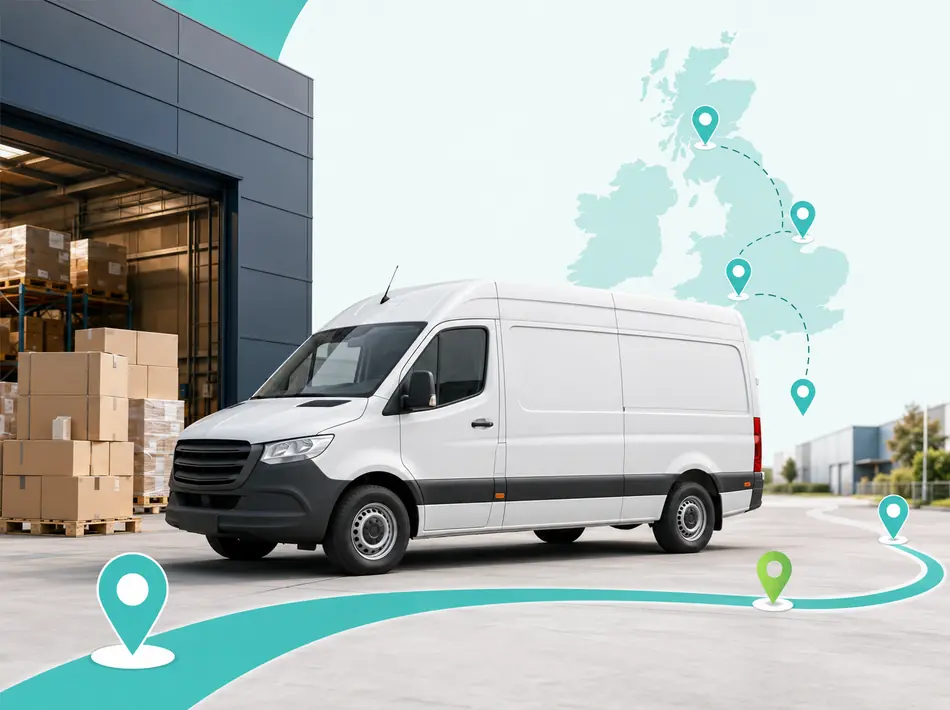
An emergency courier works on a completely different model. One vehicle, one job: collection straight through to delivery, with no depots, no consolidation points and nothing else on board slowing things down. Flextro’s emergency courier service collects from 95% of the UK within 60 minutes of booking, at any hour, any day of the week. Live GPS tracking runs from the moment of collection to the moment of arrival, so you can tell your client exactly where their goods are instead of stalling for an update that never comes.
The vehicle goes to your collection address, picks up your goods, and drives straight to the delivery address, with no stops, no depot transfers, and no delays caused by someone else’s parcel.
Which Businesses Face Delivery Emergencies Most Often?
Manufacturing and Production
When a production line stops because a component hasn’t arrived, every minute on the clock costs money. Many UK manufacturers run tight supply chains where a single missing part holds up the entire process, whether that’s a factory near Manchester or a plant in the Midlands. An emergency parts delivery can get a line running again the same morning and save hours of lost output.
Healthcare and Medical
Practices, pharmacies and care providers need urgent deliveries of medicines, equipment and samples on a regular basis. Getting the wrong item, or the right item too late, carries consequences that go well beyond an unhappy customer. Speed and accuracy both matter here, which is why healthcare organisations tend to use dedicated couriers rather than standard parcel networks for anything time-critical.
Legal and Professional Services
Court-critical documents, contracts needing a same-day signature and confidential case files all come with fixed deadlines that don’t move. Miss one in a legal context and you’ve missed a court deadline, which can have real consequences for the case and for the firm’s name. Flextro’s urgent document courier service handles exactly this kind of time-sensitive, confidential work with full proof of delivery.
Retail and eCommerce
A customer who ordered at 9am and was promised same-day delivery doesn’t want an explanation. They want the parcel. For retail and eCommerce businesses, a failed fulfilment usually ends in a refund request, a poor review, or both. An emergency courier on standby, whether the order’s heading to a flat in London or a business park outside Leeds, means you can put things right before the customer even realises something went wrong.
How to Reduce Delivery Emergencies Before They Happen
Not every crisis can be avoided, but most UK businesses could face fewer of them with a bit of groundwork.
Know your critical deadlines in advance and build in time to spare. If a shipment absolutely cannot be late, book it as a dedicated same-day service from the outset rather than hoping a standard network meets a deadline it was never designed for.
Keep a backup courier on file, one you’ve already checked out and know how to reach. The middle of a delivery crisis is the worst possible moment to start searching for options. Knowing who to call before anything goes wrong saves you fifteen minutes and a fair amount of stress right when you can least spare either.
It’s also worth asking whether a scheduled contract run would suit your business better. Regular, time-sensitive movements between fixed locations are exactly what a pre-agreed run is built for, removing the risk of a last-minute booking altogether. You know the vehicle is coming and when it arrives. There’s no gap for anything to fall through.
Frequently Asked Questions
How fast can an emergency courier actually collect my goods?
Flextro collects from 95% of the UK within 60 minutes of booking. Collection runs around the clock, so even an emergency that starts at 8pm can still be collected and delivered that same night.
Will my goods be safe if they’re fragile or high value?
Yes. Your goods are the only load in the vehicle, so there’s no risk of damage from other consignments or from being shuffled through a depot. You can also ask for a specific van size to suit what you’re sending, from a small van up to a Luton.
What information do I need to book an emergency courier?
A collection postcode, a delivery postcode, and a description of what’s being sent, including size and rough weight. Getting a quote by phone or online takes two to three minutes, and Flextro’s team can advise on the right vehicle for the job.
Why does emergency delivery cost more than a standard parcel service?
Because it’s a dedicated vehicle on a direct route rather than a shared van doing forty drops. In most genuine emergencies, though, the cost of the delay outweighs the courier fee by some distance. A stopped production line or a missed court deadline carries a financial and reputational hit that a same-day fee rarely comes close to.
Can I actually track the delivery while it’s happening?
Yes, on every job. Flextro provides live GPS tracking from collection through to arrival, so you can update your client in real time rather than promising a call back later. That visibility often matters as much to the client as the delivery itself.
What if the emergency is international, not domestic?
Domestic emergencies are covered anywhere in the UK with same-day collection. For urgent shipments leaving the country, Flextro also runs international shipping services built for time-critical freight that needs to cross UK borders fast.
When You Need to Move Fast, Call Fast
Delivery emergencies are stressful, but they don’t have to mean hours on the phone, broken promises to a client, and goods stuck somewhere you can’t influence. If you’re still deciding whether your situation actually counts as one, our guide on when to use an emergency courier can help you make the call. The right courier gets your goods collected within the hour, drives them straight to where they need to be, and keeps you in the loop the entire way.
Dealing with a delivery crisis right now? Get a quote from Flextro or call 020 4576 3438. If you’d rather have an emergency option already in place before the next one hits, get in touch with the team today.
On a production line the clock is different again — see manufacturing courier services.

Written by
Fabian Oliver — Content Writer, Flextro
Fabian is a content writer at Flextro, a UK-based dedicated courier and same-day delivery company. He writes clear, practical guidance on courier services, logistics, and delivery for UK businesses — from same-day and emergency deliveries to pallet freight, eCommerce fulfilment, and contract runs. Drawing on the expertise of the wider Flextro team, Fabian helps business owners make smarter, safer decisions about moving their goods, without the jargon.