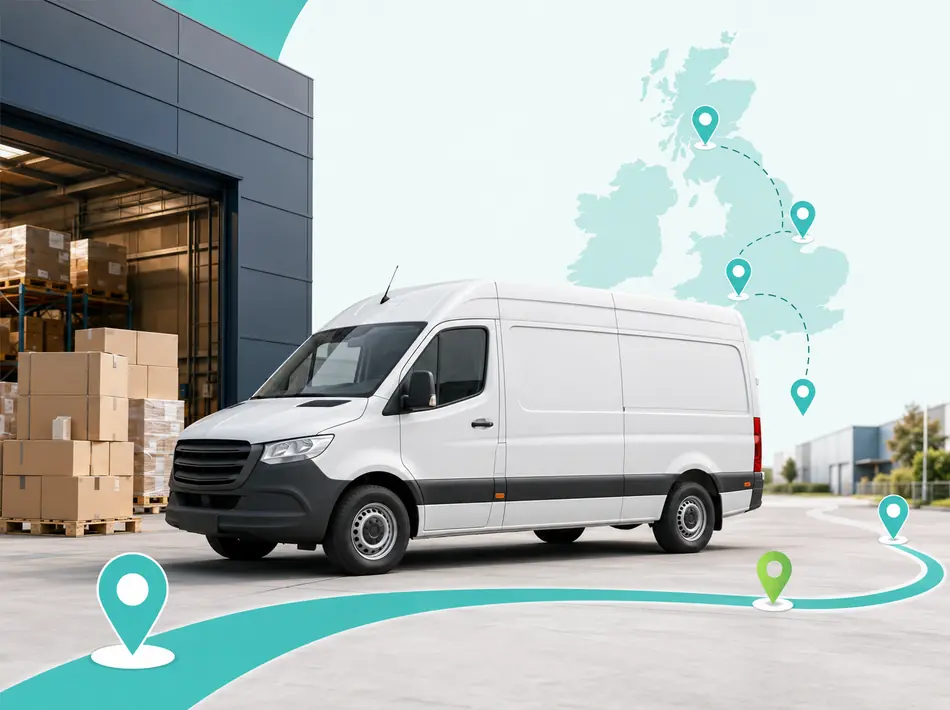
Sending five separate vans to five addresses in the same postcode costs money you don’t need to spend. Multi-drop delivery for UK businesses puts one vehicle and one driver on a planned route covering several stops in a single run. Done properly, it’s usually the biggest saving available on your delivery bill, but only if the route gets planned right in the first place.
What Is Multi-Drop Delivery?
Multi-drop delivery means one driver, one vehicle, multiple addresses, all covered on a single run. Instead of booking a separate courier for every customer, you group several drops into one route and get them all delivered in one trip.
It’s how wholesalers keep multiple shops stocked, how manufacturers reach several sites in a week, and how food and drink suppliers turn round hospitality deliveries without running a fleet of their own. If you’re sending five or more parcels to addresses in the same area, multi-drop works out cheaper than booking each one separately.
When Does Multi-Drop Make Sense for Your Business?
Multi-drop suits businesses with a delivery pattern that repeats. If you’re sending stock to the same handful of postcodes every week, a planned multi-drop route costs less per drop and creates far less admin than booking jobs one at a time.
Delivery windows matter too. A shop that needs stock on the shelf before opening, or a site that needs materials by 8am, needs a courier who plans the whole route around that constraint rather than treating it as an afterthought.
We see this pattern most clearly with retailers running multiple outlets in and around Manchester, where five or six stores across the city work out far cheaper to serve on one planned route than with five separate van bookings. Where multi-drop struggles is genuinely scattered work: ten addresses spread across five counties with no shared route is harder to make cost-effective than ten addresses in one city.
How to Plan a Multi-Drop Route That Actually Works
Cluster by postcode before you touch a timetable
Start with a map rather than a spreadsheet. Group your addresses by postcode district and work out the most sensible order to visit them. A route that zigzags across a region burns fuel and time for no reason. One that moves steadily in a single direction keeps the driver on schedule and keeps your costs down.
Lock in the time-sensitive stops first
If one customer has a fixed delivery window, that stop dictates the shape of the whole route. Plan backwards from it, then fit everything else around the gaps. Getting this order wrong is the single most common reason multi-drop routes run late.
Build in real buffer time
UK van traffic is genuinely higher than it used to be. Vans now account for 17% of all motor vehicle traffic on Great Britain’s roads, with van mileage up 1.1% on the year and running 10.6% above pre-pandemic levels, according to the Department for Transport’s provisional road traffic estimates. More vans on the road means less predictable urban traffic, so build 10 to 15 minutes of buffer into every stop rather than assuming a clear run.
Don’t overload the route
Eight well-spaced stops with realistic windows will beat twelve rushed ones every time. One delay on a packed route knocks back every stop that follows it. Get the rhythm right with a route the driver can comfortably complete, then add stops once you know it holds up.
What to Look for in a Multi-Drop Courier
Not every courier handles multi-drop well. Here’s what actually separates the reliable ones from the rest.
Dedicated vehicles. A courier that shares your goods in a van with other customers’ parcels hands control of your sequence to somebody else’s schedule. If their delivery runs late, yours does too. Flextro’s multi-drop delivery service runs dedicated vehicles only, so your route stays yours from the first drop to the last.
Proof of delivery at every stop. Without a signed record at each address, you’ve got nothing to point to if a customer says a parcel never arrived. Electronic proof of delivery protects you and gives your customers confidence too.
Live tracking. Knowing exactly where your driver is lets you get ahead of any delay. A five-minute message to a customer beats them standing at a locked door wondering where their delivery’s got to.
Flexibility for late additions. An extra stop sometimes turns up on the morning of a run. A courier who can slot it into the existing route without unpicking everything else saves you booking a whole separate job.
Contract Runs for Repeating Delivery Patterns
If your multi-drop route barely changes week to week, a standing contract removes the daily booking admin altogether. Flextro’s scheduled contract runs assign the same driver and vehicle to your route on a fixed schedule.
Over a few weeks, that driver learns your customers, your access points, and the quirks specific to your run. Routes get faster, pricing is agreed up front, and you’re never competing with other bookings for a van on a busy Friday. For a closer look at how these run day to day, see our guide to how scheduled courier runs work for UK businesses.
Getting the Vehicle Right
The van has to match the load, not the other way round. Undersize it and you’re splitting one route across two vehicles. Oversize it and you’re paying for space you never use.
Most urban multi-drop runs carrying parcels or trade supplies suit an LWB or XLWB, which handles the volume without struggling on narrow city streets. Bulky goods or higher volumes usually need a Luton with a tail lift instead. Businesses running regular routes around Birmingham often find this exact trade-off between city access and load size decides which van works, which is why matching the vehicle to the goods matters more than defaulting to the biggest one available.
Frequently Asked Questions
How many stops can a multi-drop van realistically manage in a day?
Most single-vehicle routes handle between 8 and 15 stops in a working day when the drops sit within the same city or region. Fewer, well-spaced stops with realistic time windows beat cramming in extra addresses that risk knocking on delays. Wider geographic spread or narrow delivery windows reduce that number further.
Do I need route planning software to run multi-drop deliveries?
No, not for smaller runs. Routes with fewer than 15 to 20 stops can usually be mapped by hand, grouping addresses by postcode district and checking time windows before you sequence them. Larger or more frequent runs benefit from dedicated routing tools, but a courier partner who plans professionally removes that need either way.
What happens if a stop runs late partway through the route?
A good multi-drop courier builds buffer time into the schedule so a single delay doesn’t cascade through the rest of the day. If a stop is running behind, live tracking lets your driver or your courier’s control team update the next customer before they’re left waiting.
Can multi-drop delivery work in city centres with restricted access?
Yes, provided the vehicle and route are planned around those restrictions in advance. Narrow streets, loading bay limits, and low emission zones all affect which van size and arrival time work for a given address, so this needs factoring in before the route is confirmed rather than on the day.
Is multi-drop only worth it for regular, repeating deliveries?
It works best for repeating patterns, but a one-off run with several drops in the same area can still pay off. The saving comes from splitting one vehicle cost across multiple addresses, so even an occasional multi-drop job beats booking separate couriers for each stop.
What size van do I need for a multi-drop run?
It depends on the goods, not the number of stops. An LWB or XLWB van suits most parcels and trade supplies across a standard multi-drop route, while bulky items or larger volumes usually call for a Luton with a tail lift.
Worth Planning Properly?
Multi-drop delivery cuts cost and admin when someone actually plans the route instead of just booking jobs as they come in. If your business sends regular deliveries to multiple addresses in the same area, a dedicated multi-drop route or a standing contract run could bring your cost per drop down by a solid margin.
Get a quote from Flextro and find out what a properly planned multi-drop or contract run costs for your operation.

Written by
Fabian Oliver — Content Writer, Flextro
Fabian is a content writer at Flextro, a UK-based dedicated courier and same-day delivery company. He writes clear, practical guidance on courier services, logistics, and delivery for UK businesses — from same-day and emergency deliveries to pallet freight, eCommerce fulfilment, and contract runs. Drawing on the expertise of the wider Flextro team, Fabian helps business owners make smarter, safer decisions about moving their goods, without the jargon.