Nobody enjoys reopening a support ticket because a parcel never turned up. Failed deliveries cost you twice: once when you resend the order, and again when that customer quietly shops somewhere else next time. For a UK online retailer, getting delivery right first time isn’t optional. It’s what separates a five-star review from a refund request.
The Real Reasons Deliveries Go Wrong
Most failed deliveries trace back to a handful of familiar culprits. A mistyped postcode at checkout is one. Then there’s a recipient who’s out during the delivery window. But there’s a third cause retailers rarely think about: the courier network itself.
Shared-van parcel networks pack dozens of stops into a single round. When an early drop overruns, every delivery behind it slips. Drivers run out of daylight. Parcels head back to the depot, and your customer finds a “sorry we missed you” card on the mat. That isn’t a customer mistake. It’s how the network was built to run.
What a Missed Delivery Really Costs You
The obvious cost is the re-delivery charge. There’s a bigger cost that’s harder to see. Your support team spends the afternoon fielding complaint calls. You refund an order before the parcel’s even found its way back. And the customer, fed up with chasing their own purchase, doesn’t order from you again.
Online shopping isn’t a niche channel any more. Internet sales made up 29.4% of all UK retail sales in June 2026, the highest share since April 2021, according to the Office for National Statistics. That’s a lot of parcels riding on getting delivery right first time. Retailers pulling ahead make it look effortless. The ones falling behind leave customers to chase their own orders.
Practical Ways to Cut Your Failed Delivery Rate
Get Your Address Capture Right at Checkout
Checkout is where most failed deliveries start. A postcode lookup or address-autocomplete tool cuts down on typos and half-finished addresses. It’s a small fix with an outsized effect on your failed delivery rate.
Ask for a mobile number too. A good courier driver can call or text the recipient if something’s not right at the door. That single step heads off plenty of missed deliveries before they happen.
Give Customers a Delivery Window They Can Trust
A vague delivery window helps nobody. Tell a customer their parcel is coming “sometime between 8am and 6pm” and they can’t plan their day around it. They nip to the shops. The van turns up. Nobody’s home.
Tighter, more accurate windows give people an actual chance of being in. If your courier offers live tracking, pass that link straight to your customer the moment the order’s collected. Fewer missed deliveries and far fewer “where’s my order?” messages land in your inbox as a result.
Match the Courier to the Job
Not every parcel belongs on a standard parcel network. High-value goods, time-critical orders, fragile items, and deliveries that need a particular vehicle size all deserve a different approach.
When a failed delivery simply isn’t an option, a same-day courier with a dedicated vehicle earns its keep. Your goods travel straight from your door to the recipient’s, with no depot stop, no shared van, and nothing else on board to slow things down. It’s about as close to a guaranteed first-time delivery as you’ll get.
Always Capture Proof of Delivery
Proof of delivery protects you and reassures your customer. A time-stamped photo, a signature, or a digital receipt settles any argument about whether an order actually arrived. It also cuts down on fraudulent “item not received” claims, which are becoming more common for UK online retailers.
If your current courier can’t tell you exactly when a parcel landed and who signed for it, that’s a gap worth closing before it costs you more.
When a Standard Parcel Network Isn’t Good Enough
Shared parcel networks are fine for low-value, non-urgent goods where an occasional failed delivery is a cost you can absorb. For higher-value orders, perishables, or anything time-sensitive, a shared van stops being good enough.
Depot-to-depot networks add handling at every stage. More handling means more risk. A parcel that’s reloaded twice before reaching your customer has had two extra chances to go missing, get delayed, or arrive damaged. And that’s before you factor in the shared-van scheduling problem that pushes late drops to the end of every round.
How a Dedicated Courier Brings Your Failed Delivery Rate Down
A dedicated courier collects your goods and drives them straight to the customer. There’s no shared van, no depot stop, and nothing else on the route slowing things down.
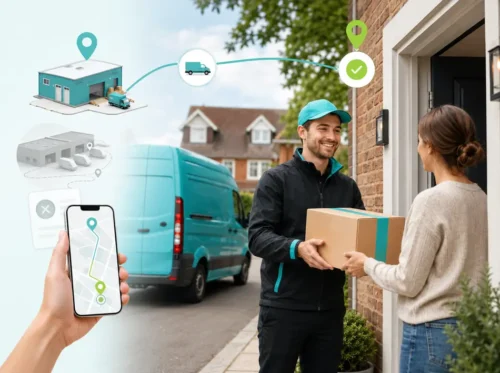
Flextro’s ecommerce fulfilment service puts a dedicated vehicle on every job, with live GPS tracking from collection through to arrival. You and your customer can watch the parcel move in real time. If the driver reaches the address and nobody answers, you find out immediately rather than waiting on a depot scan to tell you where things stand.
If this level of reliability needs to become part of your regular operations, opening a courier trade account makes the process repeatable rather than requesting a fresh quote every time. It suits businesses sending multiple orders a day particularly well.
Get Ahead of Peak Season Before It Gets Ahead of You
Failed delivery rates climb during busy trading periods. More parcels move through the network, drivers face tighter deadlines, and the margin for error shrinks. If your business has predictable peak weeks, sort your courier arrangements out ahead of time rather than leaning on an already-stretched shared network.
That’s especially true if you’re shipping out of a major hub like London, where parcel volumes run highest and shared networks feel the strain first.
It’s worth remembering how fast this sector is growing too. UK postal and courier activity expanded by 2.9% in the three months to June 2026, according to the Office for National Statistics. More volume in the network means more competition for driver time, which makes planning ahead even more valuable.
For next-day courier bookings, cut-off times matter more than most businesses realise. Miss the cut-off by even an hour and your order slips to the next working day. During peak season, that delay snowballs fast. Building your order processing around those cut-off times is one of the simplest ways to head off late and failed deliveries before they start.
Frequently Asked Questions
What counts as a failed delivery?
A failed delivery is any attempt where the parcel doesn’t reach the recipient. Common causes include nobody being home, an incorrect address, access problems at the property, or a driver running out of time on a shared round. It usually triggers a re-delivery attempt or a return to depot.
How much does a failed delivery cost an eCommerce business?
It depends on the goods and the courier involved. Direct costs include re-delivery charges and returns handling. Indirect costs include staff time on complaint calls, refunds, and customers who don’t come back. For high-value or urgent goods, the indirect cost is often far higher than the re-delivery fee itself.
Does a dedicated courier actually reduce failed deliveries?
Yes. A dedicated courier travels straight from collection to delivery with no shared van and no depot stops, removing several of the most common failure points in standard parcel networks. With one destination per driver, delivery time is far more predictable and the risk of a missed window drops sharply.
Can my customer track their delivery in real time?
Yes, every Flextro delivery includes live GPS tracking from the moment your parcel is collected. You and your customer can watch the vehicle’s progress and know exactly when it’s due to arrive. That transparency cuts down on missed deliveries and on “where’s my order?” messages.
What should I do when a delivery fails?
Contact your courier straight away to rebook the delivery or arrange a collection from depot. Then work out why it failed: was it an address issue, a timing issue, or a driver capacity issue? If the same problem keeps happening with one courier, it’s worth switching to a provider with a stronger first-time delivery record.
Is same-day delivery available for UK eCommerce orders?
Yes. For orders where reliability really matters, same-day courier is a strong option. Flextro collects from most of the UK within 60 minutes of booking and delivers direct to your customer the same day, which is especially useful for high-value orders, business deliveries, or urgent replacements.
Make First-Time Delivery the Rule, Not the Exception
Your customers expect their order to turn up when it’s supposed to. Your competitors are already working out how to make that happen. If failed deliveries are quietly costing you money and repeat business, the fix usually starts with the courier you choose and the process you build around them. Get a free quote today and see what a dedicated, same-day approach can do for your failed delivery rate.
Retailers running stores as well as a website should also see retail courier services.

Written by
Fabian Oliver — Content Writer, Flextro
Fabian is a content writer at Flextro, a UK-based dedicated courier and same-day delivery company. He writes clear, practical guidance on courier services, logistics, and delivery for UK businesses — from same-day and emergency deliveries to pallet freight, eCommerce fulfilment, and contract runs. Drawing on the expertise of the wider Flextro team, Fabian helps business owners make smarter, safer decisions about moving their goods, without the jargon.